
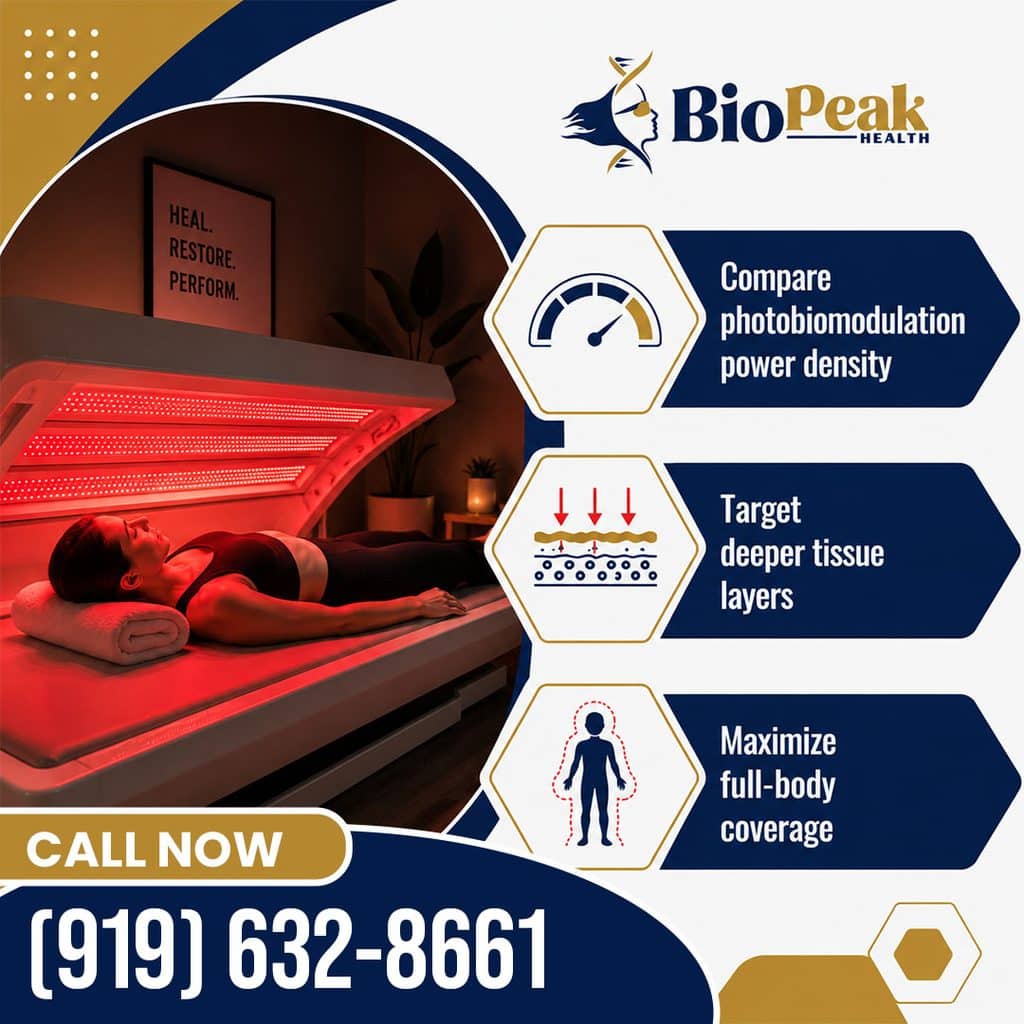
Yes, the device matters. Wavelength, irradiance, and treatment coverage determine whether photobiomodulation therapy actually reaches target tissue at an effective dose. A small handheld panel cannot replicate what a full-body red light therapy chamber delivers in a single session. BioPeak Health in Raleigh has one of the most powerful full-body chambers available, built to expose the whole body to a therapeutic dose at once. The equipment is the difference between a therapeutic dose and a warm light show.

Key Takeaways:
- Wavelength: Most clinical protocols use red and near-infrared light between 600 and 1100 nm, a range researchers call the “optical window” for tissue penetration.
- Dose consistency: A 2025 review found that wavelength, fluence, and pulse mode vary widely across devices, and inconsistent reporting of these settings limits how reproducible results are.
What Makes One Red Light Device Different From Another?
Three variables separate an effective device from an underpowered one: wavelength, irradiance, and the size of the area it treats at once. A device can use the correct wavelength and still underperform if the light isn’t strong enough, or if it only covers a few square inches of skin.
Wavelength
Visible red light (roughly 600 to 700 nm) works closer to the skin’s surface, while near-infrared light (700 to 1100 nm) reaches deeper into muscle and joint tissue. Devices combining both ranges address surface skin concerns and deeper muscle recovery therapy needs in one session.
Power Density
Two panels can list the same wavelength and still deliver different results if their output power differs. Researchers studying muscle and nerve tissue have noted that inconsistent power density reporting across studies makes it hard to compare device outcomes.
Treatment Area
A handheld wand may need to be moved dozens of times to cover the back, hips, and legs. A full-body chamber exposes tissue on a larger scale in one sitting, which matters for anyone treating widespread soreness rather than a single spot.
How Do Infrared Light Treatments Compare to Visible Red Light?
Infrared light treatments reach further into tissue than visible red light because longer wavelengths scatter less as they pass through skin. Studies across oncology, dermatology, and airway disease research have used red to near-infrared wavelengths between roughly 630 and 940 nm specifically for this deeper reach. For anyone comparing red light benefits for skin versus deeper muscle tissue, the wavelength range matters more than the brand name on the panel.
Device Comparison at a Glance
| Device Type | Typical Wavelength | Coverage Area |
| Handheld panel | Red only (~630-660 nm) | Small, spot treatment |
| Standing panel | Red + near-infrared | Front or back of body |
| Full-body chamber | Red + near-infrared | Entire body at once |
| Class IV laser | Near-infrared only | Small, targeted spot |
What Should You Look for in a Provider?
- Wavelength range: Confirm the device uses both red and near-infrared light, not a single wavelength.
- Documented power output: Ask about the device’s irradiance, since underpowered panels need much longer sessions to approach research-backed doses.
- Coverage area: A full-body device treats more tissue per session than a spot panel.
- Clinical oversight: A provider who pairs the device with an assessment can tailor session frequency to the individual.
Ready to Try Full-Body Red Light Therapy in Raleigh?
Device quality is the variable most people never think to ask about, and it’s the one that decides whether a session actually delivers a therapeutic dose. At BioPeak Health, we built our treatment room around the most powerful full-body chamber available, so patients get real coverage and output rather than a weak panel stretched over too large an area. Call/Text us at (984) 355-8822 or email [email protected] to book a session of full-body red light therapy in Raleigh.
Frequently Asked Questions
Does a stronger light always mean a better session?
Not necessarily. Power needs to match the wavelength and goal. Too little under-doses the tissue; too much without proper filtering can create heat instead of a therapeutic effect.
Can red light therapy replace physical therapy or chiropractic care?
No. It is generally used alongside other rehabilitation approaches, not as a standalone replacement for a treatment plan built around a diagnosis.
How often should sessions happen?
Frequency varies by individual and goal. Research protocols above ranged from a single session to repeated sessions over several weeks.