
A bulging disc pushes outward, but its outer wall stays intact. A herniated disc has a tear that lets inner material leak out. A ruptured disc is the most severe form, where the outer wall splits fully. All three cause lower back pain in different ways, so anyone considering back pain treatment in Raleigh should know which one they have. At BioPeak Health, we evaluate each case individually before choosing a course of care.
What Are Bulging, Herniated, and Ruptured Discs?
Bulging Disc
The annulus, the disc’s tough outer layer, stretches beyond its normal space without tearing. The disc looks swollen on an MRI, but the inner material stays contained. Bulging discs are common with age and often cause no chronic back pain at all. One MRI study of 36 adults without low back pain or sciatica found bulging discs in 29 volunteers (81%), showing that disc abnormalities can occur even without symptoms. A bulge that presses on a nerve can cause dull aching or mild lumbar back pain.
Herniated Disc
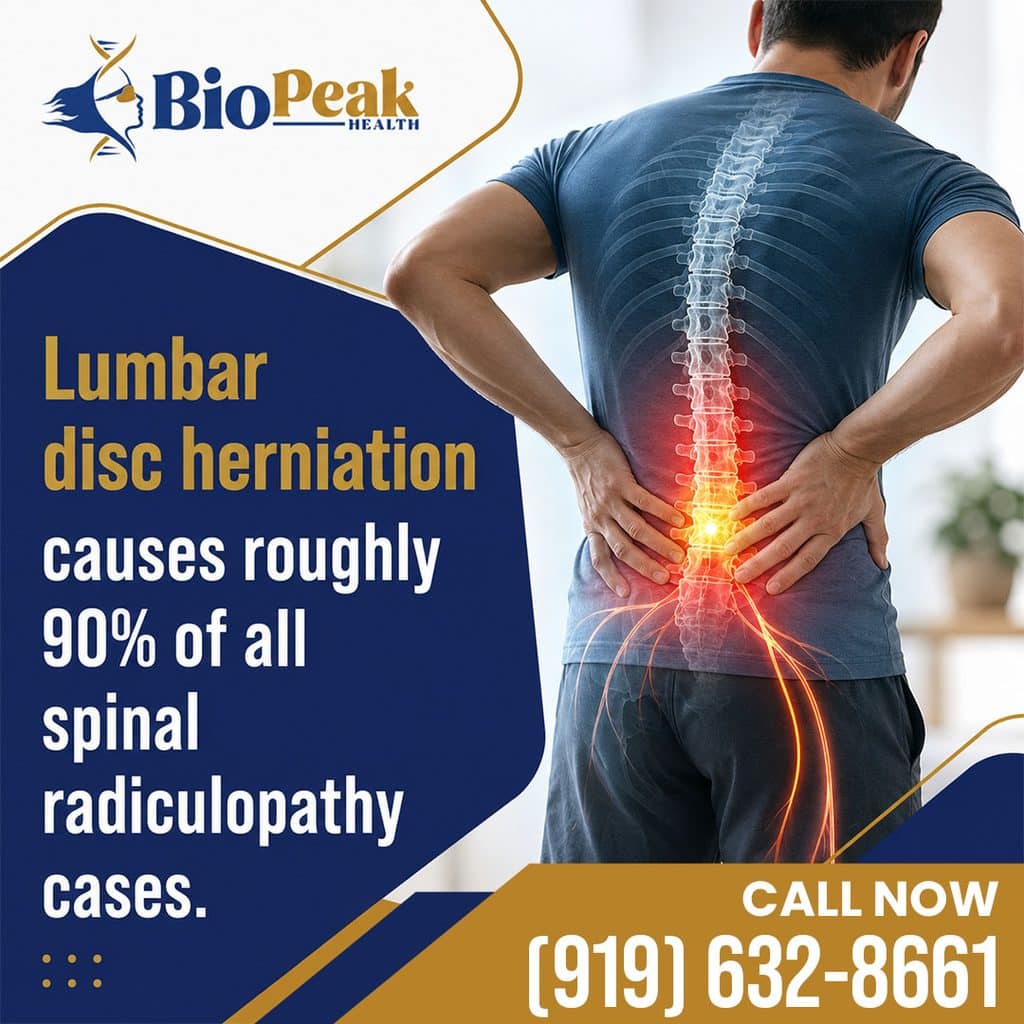
The annulus tears and the soft inner core pushes through the crack. This goes a step further than a bulge because the disc’s structural wall is compromised. Lumbar disc herniation affects 0.65% to 3.7% of adults under 45 and causes about 90% of radiculopathy cases, nerve pain that radiates into the arms or legs. Symptoms often include sharp pain, numbness, tingling, or weakness.
Ruptured Disc
The outer wall splits fully, and disc material can break away from the disc space entirely. This is the most severe stage of herniation and carries the highest risk of nerve compression. It may cause sudden, severe pain or leg weakness. Loss of bladder or bowel control is a medical emergency and needs immediate care.
Bulging vs. Herniated vs. Ruptured Disc
| Factor | Bulging Disc | Herniated Disc | Ruptured Disc |
| MRI appearance | Broad, even swelling | Focal tear with visible protrusion | Free fragment separate from the disc |
| Onset | Gradual, often unnoticed | Can be gradual or sudden | Usually sudden |
| First-line approach | Activity modification, monitoring | Non-surgical care, physical therapy | Urgent evaluation, possible surgical referral |
| Typical recovery window | Weeks | Six to eight weeks with targeted therapy | Varies; depends on nerve involvement |
| When to seek immediate care | Rarely needed | If symptoms worsen or don’t improve | If bladder, bowel, or rapid weakness symptoms appear |
Where Can Someone Find Back Pain Relief in Raleigh?
Anyone with lower back pain, sciatica, numbness, or weakness lasting more than a few weeks should get evaluated before it progresses toward a herniation or rupture. Patients at BioPeak Health start with a review of X-rays, MRIs, and orthopedic findings. We’re the only clinic in North Carolina certified in Isolation Disc Therapy, a technique which isolates and decompresses the specific disc involved instead of the whole spine.
Ready to Schedule Your Visit?
Don’t wait for a bulging, herniated, or ruptured disc to get worse. Call us at (984) 355-8822 or email [email protected] to schedule an evaluation. Reach out today for back pain relief that fits your diagnosis.
Frequently Asked Questions
Can a bulging disc turn into a herniated disc?
Yes. The same disc can develop a tear in the annulus over time, at which point it’s classified as a herniation rather than a bulge, though not every bulge progresses this way. Staying active and avoiding prolonged awkward positions may help support disc health, though research on how much this changes progression is still limited.
Does a herniated disc always require surgery?
No. Many herniated discs respond to non-surgical care, though outcomes vary by severity. A provider can help determine which approach fits a specific case after reviewing imaging and symptoms.
Is a disc problem always the cause of back pain?
No. Muscle strain is one of the most common causes of back pain and doesn’t involve the disc at all. Facet joint irritation is another common cause, with estimates putting its role in chronic low back pain anywhere from about 15% to nearly 60% of cases, so it’s worth ruling out alongside disc issues.